Views: 0 Author: Site Editor Publish Time: 2026-05-27 Origin: Site


Chemical concentrates offer excellent shipping and storage efficiencies. However, end-users frequently miscalculate manual dilution ratios. This frequent user error leads to product failure, environmental waste, or severe safety hazards. Brands can solve this by integrating a closure directly as the applicator. This approach transforms raw concentrates into Ready-to-Spray (RTS) solutions. The shift drastically lowers the entry barrier for both commercial and residential users.
We provide packaging engineers, product managers, and chemical brands a clear, evidence-based framework in this article. You will learn how to evaluate, select, and successfully implement these sprayers into your existing product lines. By understanding hydrodynamics and safety compliance, you can elevate your product packaging. Discover how to protect your brand reputation while delivering an exceptional user experience.
**User Experience:** Built-in sprayers eliminate manual measuring, mixing, and the need for secondary equipment, directly reducing end-user friction and chemical exposure.
**Precision Control:** Industrial-grade sprayers provide fixed or adjustable dilution ratios calibrated for standard municipal water pressure (typically around 60 PSI / 2 GPM), ensuring consistent application.
**Compliance & Safety:** High-quality units feature mandatory anti-siphon valves (backflow preventers) to protect household and commercial water supplies from chemical contamination.
**Supply Chain Integration:** Selecting universally compatible designs (standard neck threads) and chemically resistant materials (like Polypropylene) minimizes downstream bottling and leakage risks.
Traditional concentrate packaging relies entirely on the end-user. They must accurately measure chemical ratios. They must transfer these raw chemicals into manual pump sprayers. This outdated process introduces a significantly high margin of error. When users measure incorrectly, they risk over-application. Too much chemical easily harms sensitive turf or damages exterior surfaces. Conversely, under-application yields highly ineffective results. Consumers often blame the brand when the product fails to perform.
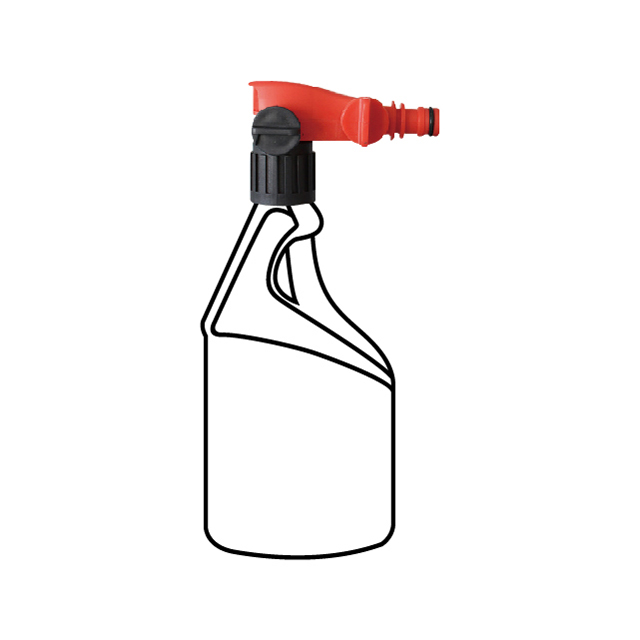
A well-engineered hose end sprayer acts as both the shipping closure and the primary application device. It relies strictly on hydrodynamic force, known as the Venturi effect. It removes user math from the equation entirely. Water flows through the unit and creates a precise vacuum. Brands guarantee their formulation applies exactly as the laboratory engineered it. This creates a frictionless experience from the store shelf to the backyard.
Brands offering RTS packaging immediately command a premium shelf presence. They shift from selling a raw, intimidating "chemical" to selling a safe, complete "solution." Marketing campaigns can heavily emphasize convenience, speed, and safety. Customers happily pay more for products requiring zero extra equipment. By removing the mixing step, you reduce consumer hesitation and drive higher adoption rates.
Understanding the mechanics of aspiration reveals how these devices achieve such high accuracy. Water passing rapidly through the internal sprayer head creates a localized pressure drop. This vacuum draws the chemical concentrate up the dip tube. The device pulls the liquid at a strictly controlled rate. It mixes the chemical into the water stream just before exiting the nozzle. This dynamic mixing ensures optimal dispersion.
Brands must choose between two primary dilution control architectures. Each serves a very different market segment.
Feature | Fixed-Rate Sprayers | Adjustable-Flow Sprayers |
|---|---|---|
Calibration | Pre-calibrated by the manufacturer (e.g., locked at 100:1 or 20:1). | Features a multi-setting dial (e.g., 1 oz to 14 oz per gallon). |
Target User | Mass-market consumer products. | Professional-grade or versatile chemical applications. |
Primary Benefit | Prevents user error completely. Guarantees safety. | Provides flexibility based on job severity or surface type. |
Common Use Case | Standard lawn fertilizers, basic weed control. | Heavy-duty degreasers, pest control concentrates. |
You must evaluate necessary nozzle patterns based on your specific chemical type. Different formulations require completely different physical dispersion methods. The correct nozzle ensures maximum efficacy.
Mist: Ideal for foliar applications. It creates tiny droplets. These coat plant leaves evenly without causing heavy runoff.
Shower/Stream: Best for lawn treatments and deep soil penetration. It delivers high volumes of diluted product directly to the root zone.
Foaming: Essential for vertical surface cleaning. Foam increases the chemical dwell time. It allows active ingredients to break down dirt or algae before gravity pulls them away.
Educated end-users and strict regulatory bodies share one primary concern. They fear the risk of chemical concentrate siphoning backward. If municipal water pressure drops suddenly, a vacuum forms in the supply line. Without protection, raw chemicals get sucked into the clean household water supply. This backflow threat presents massive liability risks for chemical brands.
Evaluating sprayers for reliable, built-in one-way valves is absolutely non-negotiable. These anti-siphon features prevent any reverse flow. They protect public health and ensure strict plumbing code compliance. Many hardware stores refuse to stock RTS products lacking certified backflow prevention. You must demand technical specifications from your packaging supplier regarding these safety valves.
Precise flow control also limits dangerous chemical runoff. Runoff harms local waterways and damages ecosystems. Sprayers calibrated correctly stop dispensing when surfaces become adequately saturated. They prevent chemical pooling on concrete or hardscapes. These hardware choices help brands align with EPA directives. Following environmental stewardship guidelines protects the planet and builds lasting consumer trust.
Choosing the right hardware requires rigorous technical evaluation. You cannot simply attach a generic sprayer to a highly reactive chemical formula.
Material Compatibility: You must specify chemically resistant plastics. Polypropylene (PP) serves as the industry standard for reservoirs. However, you must evaluate internal O-rings, gaskets, and nozzles independently. Test them against the specific pH and solvent properties of your formula. Harsh solvents degrade cheap rubber quickly.
Dual-Control Usability: Evaluate models featuring independent controls. Provide one control for water flow. Provide another for the chemical mixture. This specific setup allows users to utilize a "Water Only" rinse mode. They can wash down adjacent surfaces without detaching the bottle. This dual-action capability acts as a very strong competitive feature.
Thread and Neck Compatibility: The sprayer head must fit standard industry bottle necks seamlessly. Common sizes include 28-400 or 28-410 finishes. Precise matching avoids expensive re-tooling on your existing bottling lines. It also prevents cross-threading during assembly.
Leak-Proofing and Transit Integrity: Assess the sprayer’s primary sealing mechanism carefully. It must withstand intense vibrations. It faces extreme temperature fluctuations and pressure changes during global shipping. Concentrated formulas must never leak inside corrugated master cartons.
Hardware constraints dictate what formulas you can package successfully. Hose end sprayers cannot process highly viscous liquids. Thick gels clog the narrow internal pathways instantly. They also fail on formulas requiring constant physical agitation. Granular suspensions settle at the bottom. You must test your specific formula's flow rate rigorously. Push it through the target dip tube and orifice to verify performance.
Establish strict baseline performance testing before full production. Test the units at various real-world PSI levels. Standard residential setups average 40-60 PSI. Rural well water systems often drop lower. You must ensure the dilution ratio remains within acceptable efficacy margins across these varying pressures. Quality hardware utilizes engineered orifices. These internal structures stabilize the siphoning rate despite external pressure shifts.
Manufacturing facilities face unique cross-contamination risks. Bottling lines must flush and clean systems aggressively. This matters most when switching between different chemical products utilizing the exact same sprayer hardware. A tiny residue of non-selective herbicide inside a sprayer will destroy a customer's lawn if later used for fertilizer. Documented cleaning procedures prevent catastrophic product recalls.
Transitioning to a Ready-to-Spray packaging model represents a high-ROI decision. It protects your brand reputation immediately by minimizing end-user error.
It guarantees product efficacy because the device handles the dilution math accurately every single time.
Start your implementation by shortlisting suppliers based purely on anti-siphon certifications and material safety data.
Request physical samples early. Conduct thorough viscosity and material compatibility testing in your lab.
Run small-batch calibration tests against your specific chemical formulas to verify real-world performance across varying water pressures.
A: Most commercial sprayers fit standard neck finishes like 28-400 or 28-410. However, you must test the threading and gasket compression specifically with your chosen reservoir bottle. This testing guarantees a leak-proof seal during global transit. Do not assume universal compatibility without physical testing.
A: Yes, they are highly safe if you select the proper hardware. The chosen unit must include a high-quality, built-in anti-siphon valve. This backflow preventer blocks chemicals from reversing into clean water lines. You must verify this critical specification with your manufacturer before procurement.
A: Manufacturers calibrate most sprayers for standard residential pressure, yielding roughly 60 PSI and 2 GPM. Extreme pressure drops can marginally affect the siphoning rate. However, quality commercial hardware uses specially engineered orifices. These internal structures stabilize the chemical ratio across reasonable household pressure variations.
A: No. The chemical must remain a fully water-soluble liquid. Its viscosity must stay low enough for the Venturi effect to draw it up the dip tube. You must pre-dissolve granular products. Heavy physical suspensions will quickly clog the intricate internal mechanisms.


