
Please Choose Your Language
T: +86-13606865631
E: sales@ilotchina.com
E: sales@ilotchina.com
No. 92, Mengdu Road, Jiaojiang, Taizhou, Zhejiang, China
Views: 0 Author: Site Editor Publish Time: 2026-08-28 Origin: Site


Managing pest infestations in mature, high-canopy trees presents a severe logistical challenge for property owners and groundskeepers. Standard pump-up sprayers lack the internal pressure required to push liquids vertically, failing to penetrate foliage above 10 to 15 feet. This limitation leaves upper canopies entirely vulnerable to destructive pests and rapidly spreading fungal diseases. It also introduces severe safety risks when users resort to climbing ladders with pressurized chemical tanks strapped to their backs just to gain a few extra feet of vertical reach. You need a safer, more effective approach that does not require investing in commercial-grade, gas-powered equipment.
The Trombone Sprayer is a specialized, manual, high-reach tool designed specifically to bridge this gap in canopy management. Operating on a slide-pump mechanism, this device allows users to project liquids to impressive heights while keeping both feet firmly planted on the ground. We will evaluate its realistic vertical reach, operational mechanics, physical trade-offs, and overall viability for tall tree pest control.
Realistic Reach: A fully primed trombone sprayer can consistently reach vertical heights of 20 to 30 feet, heavily dependent on liquid weight, viscosity, and operator strength.
Continuous Supply & Efficiency: Unlike fixed-tank sprayers, trombone sprayers utilize a bucket-fed intake system, allowing for theoretically unlimited treatment volume and the ability to treat an entire property in less time without depressurization interruptions.
Operational Trade-offs: The manual push-pull mechanism requires significant upper-body exertion, making it highly effective for targeted applications but potentially fatiguing for large-scale property management.
Application Scope: Ideal for applying dormant oils, fungicides, and insecticides to mature fruit trees, while easily adjusting to treat low-growing plants and shrubs, provided wind drift and chemical runoff are properly managed.
Standard garden sprayers rely on compressed air trapped inside a sealed plastic or steel tank. As you spray, the air volume expands, the internal pressure drops, and the vertical reach diminishes rapidly. You must constantly stop, set the wand down, and manually pump the handle to rebuild that lost air pressure. This design fails completely when you need to push heavy liquids 25 feet into the air. The slide-pump design abandons the pressurized air tank entirely, opting instead for direct fluid displacement.
The core of this high-reach tool is its dual-action hydraulic mechanism. Instead of pressurizing a tank of air, you physically move a piston back and forth inside a brass or heavy-duty plastic cylinder. This mechanism generates high pressure on both the inward and outward strokes. The internal mechanics rely on a simple but highly effective sequence of check valves, usually utilizing stainless steel or glass balls seated against brass fittings.
You pull the handle back, creating a vacuum inside the main cylinder.
The vacuum lifts the internal intake check valve, drawing liquid up through the hose and into the chamber.
You push the handle forward, which instantly seats the intake valve shut so liquid cannot flow backward down the hose.
The forward pressure forces the discharge valve open, driving the liquid out through the nozzle at high velocity.
Because the pump works on both halves of the stroke, this continuous pressure translates directly into a steady, unbroken stream.
You are the engine driving the fluid. The faster and harder you pump, the higher the pressure climbs. This direct mechanical advantage allows the liquid to overcome gravity, maintaining a tight stream that can punch through lower branches and reach the upper canopy of mature trees without the pressure drop-off associated with compressed air tanks. Maintaining the internal cup seal—usually made of synthetic rubber or leather—with regular applications of silicone grease ensures the pump maintains maximum vacuum and discharge pressure.
The most distinct logistical advantage of this equipment is its intake system. You do not wear a heavy, sloshing tank on your back, nor do you drag a pressurized cylinder across the lawn. Instead, you draw directly from a mixed bucket, barrel, or drum. You drop the intake hose into a five-gallon bucket of your pre-mixed dormant oil or insecticide. This setup provides an unlimited range of treatment. You can mix 50 gallons of fungicide in a large drum on the back of a utility vehicle and spray continuously without ever stopping to depressurize, uncap, refill, and repressurize a small tank.
This continuous siphon allows users to treat entire properties much faster. The physical separation of the liquid reservoir from the application wand also reduces operator fatigue, as you only support the weight of the brass pump and the liquid currently inside the hose. To maintain this continuous siphon effectively, you must utilize weighted intake strainers. These components anchor the hose to the bottom of the bucket, ensuring it does not float to the surface and suck in air. They also feature fine mesh screens that filter out debris, preventing sediment from traveling up the hose and clogging the precision brass nozzle at the tip.
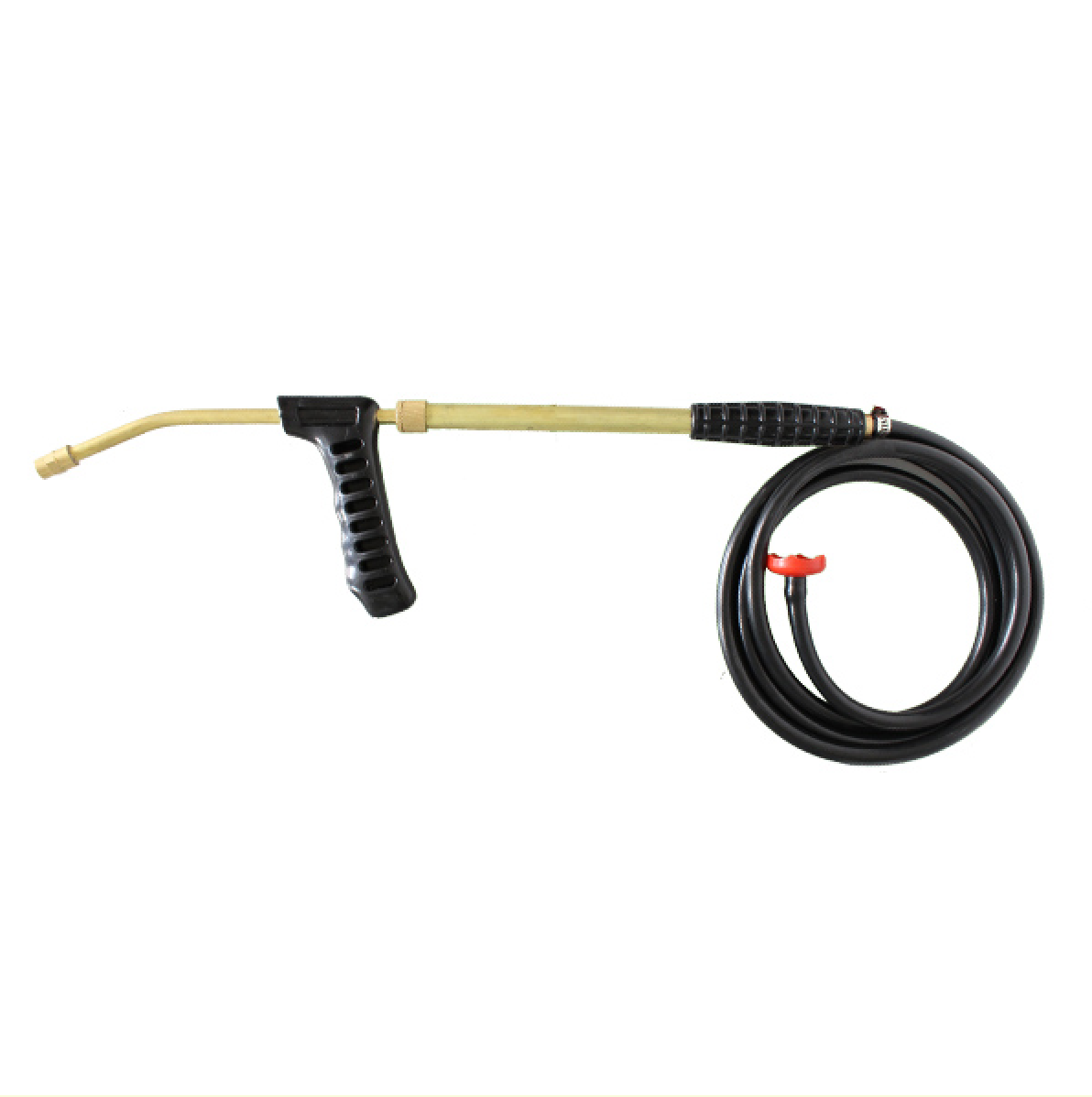
To determine if this manual tool is truly viable for high-canopy management, we must assess it based on performance metrics critical to effective pest control in the field. Vertical reach is only one part of the equation. We must also consider canopy penetration, droplet size, and operator safety.
Industry-standard models frequently advertise a vertical reach of up to 30 feet. Under optimal conditions, this claim holds up, but it is dictated by several highly variable factors. The 20-to-30-foot reach depends entirely on the operator's physical ability to maintain rapid, forceful strokes. If your pumping speed slows, the vertical trajectory drops immediately. You cannot casually pump the handle and expect the liquid to clear a two-story roofline.
Furthermore, the specific weight and viscosity of the liquid being sprayed directly impact the maximum vertical reach. Heavy dormant oils, horticultural soaps, and thick fungicidal suspensions require significantly more kinetic energy to push upward against gravity. You may only achieve 20 feet of reach with a heavy oil mixture. Conversely, lighter, water-based synthetic insecticide mixtures travel higher and faster with less physical effort, allowing you to hit that 30-foot mark.
Liquid Viscosity and Expected Vertical Reach
Chemical Type |
Viscosity Level |
Expected Max Reach (Optimal Pumping) |
Droplet State at Max Height |
|---|---|---|---|
Water-based Synthetic Insecticides |
Low (Water-like) |
28 - 30 feet |
Coarse Stream / Splatter |
Liquid Copper Fungicides |
Medium |
24 - 26 feet |
Solid Stream |
Horticultural Oils / Neem Oil |
High (Thick) |
20 - 22 feet |
Heavy Solid Stream |
Kaolin Clay Suspensions |
Very High |
18 - 20 feet |
Thick Jet |
It is also necessary to understand the loss of droplet atomization at maximum vertical range. To reach 30 feet, the nozzle must be adjusted to a solid stream. You will not achieve a fine mist at that height. The liquid hits the upper branches as a concentrated jet, which impacts how the chemical spreads across the leaf surface. The impact of the heavy stream causes the liquid to splatter and run down the branches, which is effective for bark-boring insects but less efficient for coating individual leaves.
Effective pest control requires more than just hitting the tree. The chemical must penetrate dense foliage. A solid stream traveling at high velocity can punch through outer leaves to reach the interior branches. However, because the stream is concentrated, it does not coat the foliage as evenly as a motorized mist blower would.
Shooting from a ground-level vantage point presents a unique dynamic for coverage efficacy. You are inherently aiming upward. This angle naturally targets the underside of the leaves. From a biological standpoint, this is highly advantageous. Many destructive pests, including spider mites, aphids, whiteflies, and scale insects, congregate and lay their eggs almost exclusively on the undersides of leaves to protect themselves from predators and direct sunlight. While an upward stream hits these target areas effectively, achieving complete canopy coverage requires diligence. You cannot simply stand in one spot.
Start at the trunk of the tree and aim upward into the interior canopy to coat the inner branches.
Walk backward to the outer drip line of the tree.
Begin walking in a complete circle around the drip line, pumping continuously.
Aim the stream at different angles, sweeping from the lower branches up to the crown.
Ensure the chemical penetrates from all sides to prevent leaving untreated blind spots where pests can survive and reproduce.
A high-reach tool is only valuable if it adapts to different environments. The necessity of adjustable brass nozzles cannot be overstated. A high-quality slide pump allows you to transition seamlessly between diverse tasks. By twisting the brass tip, you change the output from a 25-foot high-reach stream for treating a mature oak tree, down to a wide, fine mist for applying delicate fungicides to low-growing rose bushes and foundation shrubs.
Evaluating the integration of various add-ons maximizes the tool's utility across the whole yard. Extension wands can be fitted to some models to provide an extra few feet of reach or to bypass thorny outer branches. Heavy-duty intake hoses allow you to leave the heavy bucket stationary while you walk around the drip line of the tree. Keeping replacement O-rings and specialized Spray Accessories on hand is critical. The constant friction of the push-pull mechanism eventually wears down the internal seals, leading to a loss of pressure. Proper maintenance of these components ensures the tool remains versatile year after year.
Treating high-altitude pest infestations traditionally forces homeowners onto ladders. Operating a standard pump sprayer while balancing on a ladder is exceptionally dangerous. The recoil from the wand, the shifting weight of a backpack tank, and the physical motion of pumping easily throw an operator off balance. Ladder falls while wearing a 4-gallon backpack sprayer often result in severe orthopedic injuries.
Agricultural chemicals and water inevitably drip during application. Ladder rungs become slick, drastically increasing the likelihood of a fall. Ground-level application completely mitigates fall risks. Keeping both feet on solid ground while projecting chemicals 30 feet into the air is the only responsible choice for manual high-canopy treatments.
This tool demands physical effort and careful environmental management. You must understand the operational realities before deploying a slide pump for large-scale applications.
The most significant operational trade-off is the biomechanical strain required to operate the device. You substitute the power of a gasoline engine with your own upper-body strength. Operating a trombone sprayer for extended periods is a rigorous cardiovascular and muscular workout. The continuous push-pull action heavily taxes the shoulders, chest, arms, and core.
You must set realistic expectations based on the scale of your property. Treating a single mature backyard cherry tree or a small cluster of apple trees is entirely manageable for an average adult. Attempting to treat a 50-tree commercial orchard with a manual slide pump will result in severe physical fatigue. As your muscles tire, your stroke rate drops, which immediately reduces the vertical reach and compromises the effectiveness of the treatment. Adopting a staggered stance—one foot forward, one foot back—allows you to use your core and legs to assist with the push-pull motion, reducing isolated shoulder fatigue.
Precision agriculture relies on accurate calibration, which means applying an exact amount of chemical per square foot of canopy. Maintaining a consistent application rate with a manual pump is difficult. Your gallons per minute (GPM) output fluctuates wildly depending on how fast you pump.
Because you cannot lock in a specific pressure setting, you face a high risk of over-application. As you aim at lower branches, you might pump too aggressively, drenching the foliage and causing the expensive chemical to drip off. As you tire while aiming at the top of the tree, you might under-apply the product, leaving pests alive to reproduce. This inconsistent stroke pressure frequently leads to chemical runoff at the base of the tree, wasting money and potentially damaging the turfgrass or soil microbiome below the drip line.
Field Calibration Method
Fill your bucket with exactly one gallon of plain water.
Set a timer for 60 seconds.
Pump the sprayer at your normal, sustainable operating speed back into the bucket or onto a paved driveway.
Measure how much water remains in the bucket after 60 seconds.
Subtract the remaining water from the initial gallon to determine your exact Gallons Per Minute (GPM) rate at your specific pumping speed.
Shooting any liquid 25 to 30 feet into the air introduces a severe risk of pesticide drift. At ground level, the air might feel still, but wind speeds are often significantly higher above the roofline. When you project a stream of insecticide into the upper canopy, even a mild breeze catches the falling droplets and carries them across property lines, into water features, or onto non-target flowering plants where bees are actively foraging.
Wind Speed Guidelines for High-Reach Spraying
Wind Speed (MPH) |
Visual Indicator |
Action Required |
|---|---|---|
0 - 3 mph |
Smoke rises vertically; leaves are still. |
Ideal conditions. Proceed with spraying. |
4 - 7 mph |
Leaves rustle; wind felt lightly on face. |
Use caution. Adjust to a coarser stream to reduce drift. |
8 - 10 mph |
Small branches move; dust kicks up. |
Stop spraying. Drift risk is too high for overhead application. |
11+ mph |
Large branches sway. |
Do not spray. Severe risk of chemical trespass and operator exposure. |
Always spray early in the morning or late in the evening when thermal updrafts are minimal. Select appropriate droplet sizes by adjusting the nozzle; larger droplets resist wind drift much better than fine mists. Because you shoot chemicals directly overhead, gravity guarantees that some liquid will fall back down on you. Utilizing proper PPE—including chemical-resistant goggles, a wide-brimmed waterproof hat, long sleeves, and a respirator—is mandatory for environmental and personal safety.
No single tool is perfect for every scenario. Understanding the distinct advantages of each category ensures you deploy the right equipment for your specific canopy management needs.
High-Reach Application Equipment Comparison
Equipment Type |
Max Vertical Reach |
Power Source |
Primary Advantage |
Primary Limitation |
|---|---|---|---|---|
Trombone / Slide Pump |
20 - 30 feet |
Manual (Push-Pull) |
High reach without ladders; unlimited bucket volume. |
Causes severe upper-body fatigue; poor atomization at height. |
Backpack Pump Sprayer |
10 - 15 feet |
Manual (Lever) |
Excellent mobility; consistent pressure for fine misting. |
Fails to reach upper canopies; limited tank capacity. |
Gas-Powered Mist Blower |
35 - 50+ feet |
Gasoline Engine |
Superior canopy penetration; excellent droplet atomization. |
High purchase cost; heavy; requires engine maintenance. |
Hose-End Sprayer |
15 - 20 feet |
Municipal Water Pressure |
Extremely easy to use; no pumping required. |
Relies entirely on home water pressure; inaccurate dilution rates. |
When comparing vertical reach, the slide pump easily wins. Backpack sprayers cannot generate the burst pressure required to shoot liquids 30 feet vertically. Backpack models win decisively in mobility and ease of consistent pressure. With a backpack, you carry the liquid securely on your shoulders, allowing you to hike through rough terrain or dense brush easily. The side-lever pump on a backpack requires minimal effort to maintain a steady, fine mist. If your target pests are located on shrubs, foundation plants, or dwarf fruit trees under 12 feet tall, a backpack sprayer is the superior, more ergonomic choice.
Gas-powered mist blowers utilize a high-velocity fan to atomize the liquid and blow it deep into the foliage. They offer superior canopy penetration, coating both the tops and bottoms of leaves perfectly at heights exceeding 40 feet. They are incredibly loud, heavy to wear, and carry a heavy maintenance burden regarding fuel mixing, carburetor cleaning, and spark plug replacement. For a homeowner with three apple trees, a manual slide pump is a highly cost-effective alternative that requires zero engine maintenance.
There is a strict threshold where a manual sprayer is no longer sufficient. If your trees exceed 30 feet in height, ground-based manual tools will fail to reach the upper canopy. Severe systemic infestations, such as Emerald Ash Borer or aggressive fungal blights, often require specialized treatments like deep root soil injections or direct trunk micro-injections. These methods bypass spraying entirely. Highly regulated chemical requirements often mandate licensed applicators. If the pest problem threatens the life of a massive heritage tree, or if the canopy is simply too high to reach safely, hiring professional arborists is the only viable solution.
Measure the maximum height of your target trees to confirm they fall within the 25-to-30-foot operational range of a manual slide pump.
Purchase a heavy-duty, wide-based 5-gallon bucket and secure the weighted intake strainer to the bottom to prevent air suction during operation.
Equip yourself with mandatory personal protective equipment, including a wide-brimmed waterproof hat, chemical-resistant goggles, and a respirator to defend against overhead chemical fallback.
Perform a plain-water test run to practice your push-pull rhythm and establish a consistent stroke rate before mixing any active pesticides.
A: A fully primed unit can realistically reach vertical heights between 20 and 30 feet. This range is heavily dependent on the operator's physical pumping effort, the presence of wind, and the specific weight of the liquid being sprayed. Lighter water mixtures travel higher than heavy dormant oils.
A: Yes, they are highly compatible with dormant oils. Because dormant oils tend to separate from water, you must frequently agitate the mixture in your bucket. Since the intake hose sits at the bottom, failing to agitate the mix will result in spraying uneven concentrations of oil.
A: Absolutely. Most models feature adjustable brass nozzles. By twisting the nozzle tip, you can seamlessly switch from a concentrated, high-pressure stream designed for tall trees to a wide, fine mist perfectly suited for delicate, low-growing plants and foundation shrubs.
A: Yes, they rely heavily on specific attachments. The most critical accessories are the adjustable brass nozzles for controlling spray patterns and the weighted intake strainers. The strainer keeps the hose submerged at the bottom of the bucket while filtering out debris that could clog the pump.
A: You establish a baseline application rate by pumping the sprayer at your normal operating speed directly into a measured container for exactly one minute. This gives you your gallons per minute (GPM) rate, allowing you to calculate how long to spray a specific canopy area.
A: Yes, for tall trees, the slide pump is far superior. It offers unmatched vertical reach up to 30 feet and unlimited treatment volume via the bucket. Backpack sprayers max out around 15 feet. Backpacks offer better mobility and consistent misting for lower targets.
A: Yes, it requires significant upper-body exertion. The continuous push-pull operation acts as a rigorous workout for your arms, core, and shoulders. While it causes physical fatigue during extended use, this exertion is a worthwhile trade-off for the immense safety benefit of avoiding ladders while handling chemicals.


